
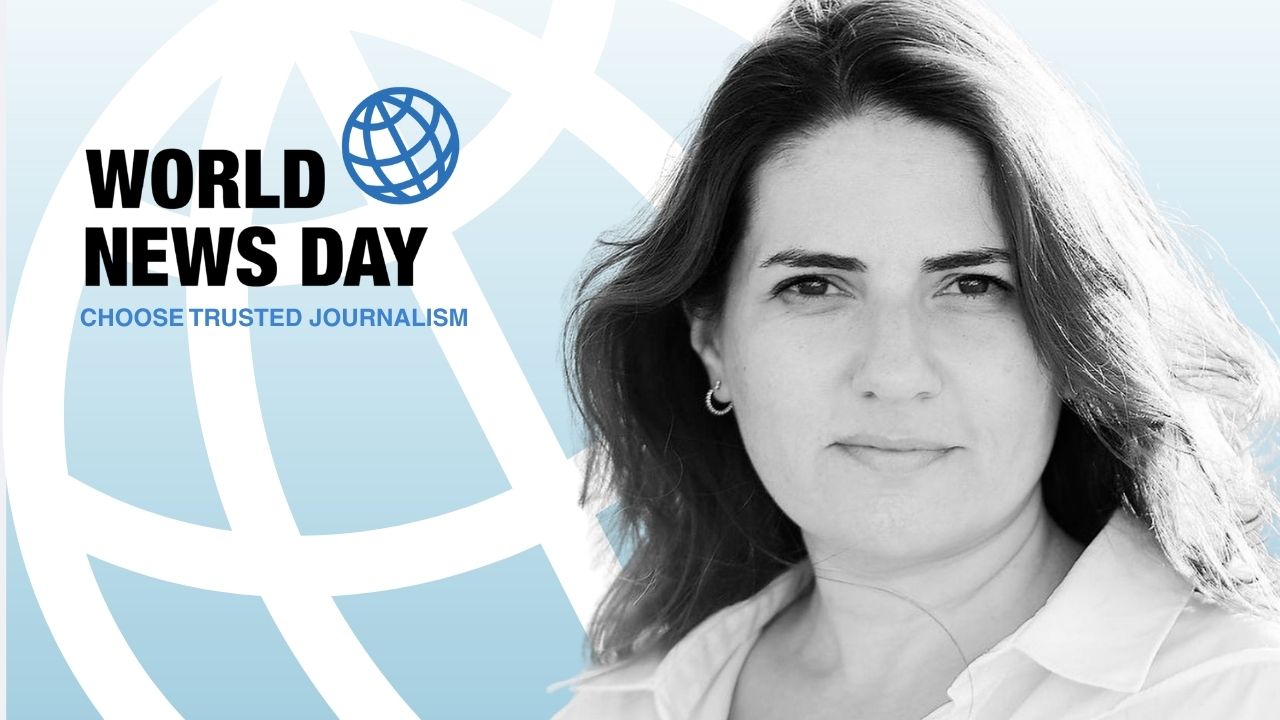
By Alia Ebrahim.
For a couple of months in 2020, my dining-room table was covered by a huge map detailing the companies connected to Lebanon’s central bank governor, Riad Salameh. We had been investigating him for months, and by then it was clear to us that he owned at least two dozen companies, many of them hidden behind names that meant nothing to anyone but us.
My eldest daughter, Yasma, was about 14 then; her sister, Mia, a little over a year younger. When they asked what the map was, I would tell them it was for work. Only later, as the investigation took shape, could I give them and their friends a simplified version of the story.
It mattered to them.
After months of work, we published our first investigation into Salameh on August 10, 2020 – less than a week after the Beirut port explosion, one of the largest non-nuclear explosions in recent history, killed more than 200 people and devastated large parts of the city.
My daughters, like many of their generation, had been going to protests since they were in strollers. Now they were back in the streets on their own feet, shouting for accountability and justice. Unlike us, they were free of the memory of the civil war. They were uncompromising about their rights. They rejected the za’im – the sectarian boss – in absolute terms.
On days when exhaustion could have kept me in bed, it was the knowledge that someone would pick up this fight after us that made me keep giving it my best.
That is why my own children’s reaction to our first piece on Salameh was so disappointing – and so clarifying:
“We love the stories the way you tell them to us. Just not the way you publish them in Daraj.”
Our first investigation showed that while more than a million depositors had lost access to their money in Lebanon, the governor’s own wealth was protected in bank accounts and assets across Europe. The series that followed uncovered evidence pointing to aggravated money laundering, illicit enrichment and conflicts of interest.
The first page of the French investigating judge’s case file states that the investigation was opened following reporting by Daraj and OCCRP. Since then, assets linked to Salameh have been frozen or seized in six European countries, and today the former governor is back in detention, indicted and facing charges in Lebanon and abroad. He has denied wrongdoing, and the judicial process must now run its course.
I do not say this to claim sole credit for what followed. Many investigators, lawyers and journalists carried the work forward. But it is proof that work begun at a dining-room table can enter a judge’s file – and that evidence can become a consequence.
Investigative journalists are familiar with, and accepting of, the idea that we may sometimes work for only a few readers. Occasionally, just one reader is enough. In this case, that reader was Aude Buresi, the French investigating judge who opened her file on the basis of our reporting.
Still, when my own children – who for months had eaten lunch on the sofa because our table had found a more urgent purpose – understood why the investigation mattered but did not want to read it as we had published it, we realised we had a problem.
By 2025, we had fifteen lawsuits against us and were working in a mainstream media ecosystem deeply influenced by the central bank and the very banks it was supposed to scrutinize. Our reporting had shown that some of those banks’ CEOs had been the governor’s business partners for more than a decade.
The question had taken many forms, but the answer remained simple.
Producing journalism is not enough if we fail to distribute it.
And distribution does not simply mean publishing a link. It means finding forms in which journalism can travel.
The passionate journalist in me wanted to care only about the first half. But as CEO of the independent media outlet I co-founded with my friends and fellow journalists, it was my responsibility to focus on the second.
That was exactly what I had in mind when, at dinner with Mia and her friends last week, I pitched my new business model with a small box of watermelon gum.
I’ll come back to that. But first, some context.
In 2016, my co-founders and I began building Daraj, which we launched the following year. We called it Daraj – Arabic for a flight of steps – because we felt we were stuck in a deep hole and needed something to help us climb out, one step at a time.
Our tagline was The Third Story because we were terrified by the polarization around us. Our call to action was simple, and it was not a metaphor: we do it or we die.
It felt existential.
A decade later, Daraj is real. It has found readers and recognition far beyond Lebanon. We have changed enormously – but the world around us has changed faster, and in more frightening ways.
It is scarier not only because of the rise of populism, misinformation and violence, but because of something underneath all of them: a massive loss of reference.
As someone who reads and appreciates history, I understand what we are living through as a transition – a world ending before another has been born. As a realist utopian, I want to believe that societies eventually find ways to correct themselves. But correction is not automatic. It happens only because people refuse to sit on their hands and wait.
Whatever comes next, for our societies, our industries and the world we share, will be shaped by what those who still believe in the public interest are prepared to act now.
Sometimes, apparently, that might include selling chewing gum.
Here is what I think has actually changed over these ten years.
The divide is no longer simply Global South versus Global North. It is no longer left versus right, generational, or conservative versus liberal. Those divisions all had something in common: two sides that disagreed about what to do, but at least agreed on what was real – what happened, what the facts were, what counted as evidence.
What is collapsing now is that shared ground itself.
This is not a new side replacing the old ones. It is the disappearance of the thing all those sides used to fight over.
That is why The Third Story – the third place, the third voice, the third option– matters more now than it did when we started, not less.
Ten years ago, it meant refusing to be pro-Saudi or pro-Iran. It meant refusing to answer to political financiers or old families instead of the public we served. That was already a hard, narrow space to hold. But at least it was nameable.
Today, The Third Story means something bigger and harder. It means insisting that an outside still exists at all: a place from which conversation remains possible when the divide itself is making conversation about anything feel impossible.
I do not say this as a claim to neutrality. I have never believed in a view from nowhere, and I do not think readers trust it either.
I say it as something we have earned, one step at a time, over ten years: through investigations that took over dining-room tables; through daughters who told us the story mattered but the way we told it did not reach them; and through every day we insisted that our first responsibility was to the public we served, and that our loyalty was to our journalism and our audience.
Which brings me back to the chewing gum.
Last week, I took Mia and her friends – all of them studying business – to dinner and asked them to help me think through how to bring young audiences not only to Daraj, but into a real relationship with it.
Of everything said that evening, two comments got to the heart of it.
“Don’t assume I don’t want knowledge just because I don’t want to read an article.”
And, when I asked whether they wanted to hear from experienced journalists at all:
“Why would I listen to stories from someone younger than me – someone I know hasn’t lived?”
They were not rejecting journalism. They were not rejecting knowledge, authority or experience. They were rejecting the assumption that an article is the only legitimate container for knowledge, or that reaching younger audiences requires journalists to imitate them.
They wanted the story. They wanted to hear from people who knew more than they did. They simply wanted us to think differently about how the story reached them.
Earlier that day, I had found a small pink box of gum with a watermelon design, and I had thought: this is a good product. Three euros for thirty tiny pieces – an absurd amount of money for gum, but perhaps not for something people buy because they want to support a cause.
When I presented the idea, my young, talented guests went a little crazy. Every argument marketing school could produce came at me: You cannot threaten your positioning. This is product placement. You need stronger selling points. And on and on.
It became one of the most heated – and enjoyable – dinners I have had with my daughter and her friends in a long time.
When they had said everything they had to say, I took a deep breath and told them that when I was growing up, our parents used to warn us that if we did not study hard and succeed, we would end up selling chewing gum on the street. Back then, the people selling gum and kaak-sesame-covered bread on the corners of Beirut were, depending on whom you asked, either beggars or intelligence agents.
And yet gum makes sense to me today if it becomes one small point in a much larger network: something sold in the bookshops and coffee shops where our audiences gather, allowing people who want to support journalism to receive something tangible in return. There could be books, card games and other products too. But gum– or postcards– might be the simplest place to begin.
The bottom line is this: selling chewing gum might be the best business idea I have had yet to save my journalism.
As I spoke, my guests listened.
“You see,” one of them said. “That is the story you should have told us from the beginning.”
By the end of dinner, we had ideas ranging from three-dollar products to thirty-thousand-dollar partnerships – and a promise from them to come back with better-designed products.
Their enthusiasm that evening gave me the same energy that had carried me through the days when I was ready to give up.
I say this as a Gen X mother of two Gen Z daughters, and as the CEO of a young newsroom where generational differences can be as maddening as they are exhilarating.
That is the distance we are operating across now: between an existential “we do it or we die” and a generation fluent in positioning and brand architecture that still, underneath all of it, showed up to fight about how to make the story land.
As loud as it became, the argument was never really about gum. It was about whether the story could survive contact with a world that no longer agrees on what a story is for.
My wonderful guests were right. Not wanting to read an article does not mean not wanting knowledge. Young people do not want journalism stripped of experience and authority. They want us to stop confusing the form with the purpose.
I do not know exactly what the next ten years of Daraj will look like. But I know the answer is not to wait for the world to correct itself.
What I am working hard on these days is learning the business side of our industry and figuring out how to build a shared infrastructure that will allow our journalism to fly, even if that means my daily life is now filled with acronyms I once hated, like KPIs and ROI, and words I once refused to say, like growth and scale.
As a correspondent, I would not even fill in my own expense sheets because all I wanted to focus on was journalism. I have surprised myself with how much I am enjoying the new hat.
Looking outward from the little newsroom we began building ten years ago, I can see, for the first time in my career, an advantage – even a head start – in knowing exactly what is at stake.
I know what a society without strong journalism looks like. I do not have to imagine it. I have lived it all my life: growing up during a civil war, reporting on fights for reform that kept failing, and now fighting to protect whatever common ground remains.
I am fighting for journalism not only as a principle, but as a point of reference – and as a reminder that no matter how deep the divide becomes, hope lies in the conversations we can still have with one another.
That is the battle I will keep fighting, even if it means selling chewing gum to save my newsroom.
Alia Ebrahim, Co-founder and CEO Daraj.com
This opinion piece was commissioned to mark World News Day, on 28 September.
Free to republish or translate in full, provided translations remain faithful to the original meaning. Minor edits for length or house style are permitted on the same basis.