
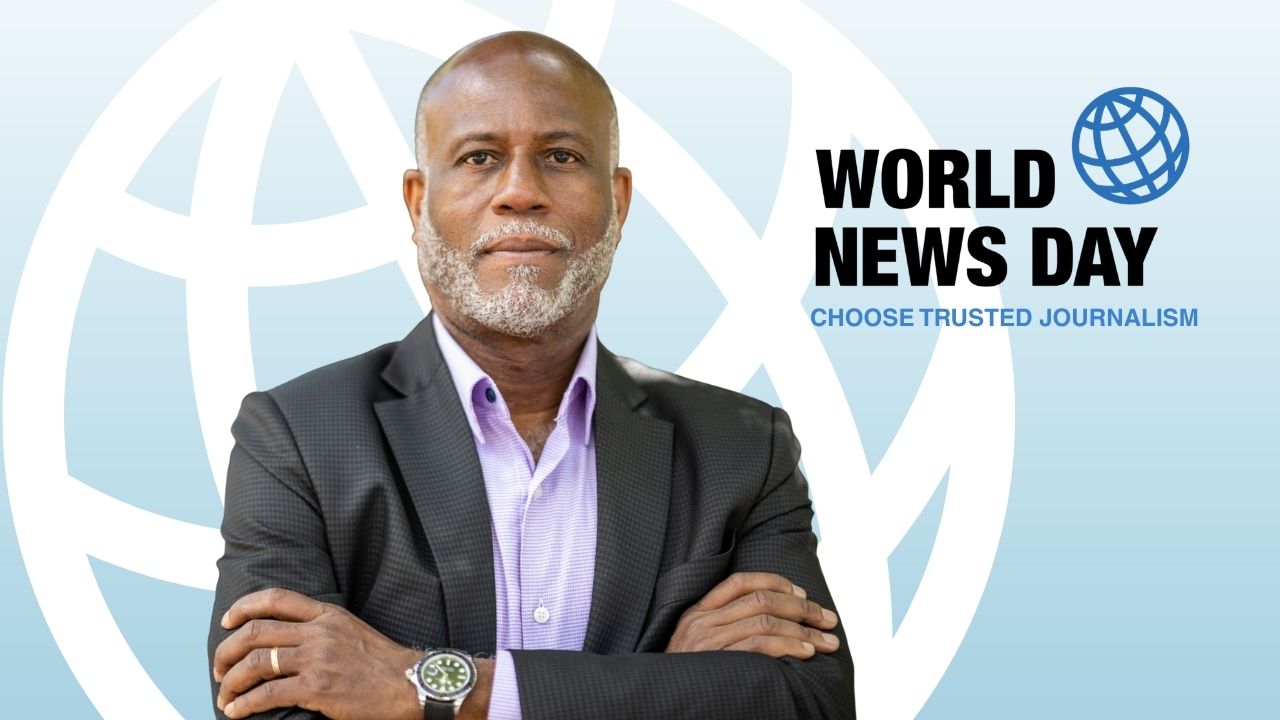
By Garry Pierre-Pierre.
Last July, news that Haitian businessman and politician Reginald Boulos had been arrested began circulating widely across social media.
The posts moved quickly. But they offered little beyond the bare claim. No details. No confirmation. Just enough information to create more questions than answers.
At The Haitian Times, the newsroom confirmed the arrest, gathered the facts and published a detailed account of what had happened.
When I shared the story on social media, one response stopped me:
“Thanks for the update. We’ve been waiting to hear from The Haitian Times for validation on this news.”
The reader already had the information. What she did not know was whether to believe it.
That distinction is worth considering on World News Day, when news organizations around the globe come together to call attention to the importance of fact-based journalism. At a moment when information is more abundant than at any time in human history, journalism faces a peculiar challenge:
Our job is no longer simply to tell people what happened. Increasingly, it is to help them determine what is real, what matters and what can actually be known.
For most of modern journalism’s history, information was scarce. Newspapers gathered it, organized it, printed it and delivered it. Radio and television expanded the reach, but the basic proposition remained the same: journalists had access to information that most people did not.
That world has disappeared, never to return. Today, information is everywhere. A witness can livestream an event before a reporter arrives. A politician can communicate directly with millions of followers. Governments, corporations, activists, propagandists and ordinary citizens all possess the means to publish instantly.
Artificial intelligence has accelerated this transformation. We can now produce convincing text, photographs, audio and video at extraordinary speed and scale. We have more information at our fingertips than any generation in human history. And yet knowing what is actually happening can feel harder than ever. That is the paradox confronting journalism.
Our challenge is no longer simply getting information to people. It is helping them determine what information means, where it came from, what is missing and whether it corresponds to reality. That requires something technology alone cannot provide: judgment.
Journalists decide which questions need to be asked. They seek evidence. They challenge assertions. They provide context. They distinguish what is known from what is suspected and, sometimes most importantly, acknowledge what cannot yet be known. These may sound like ordinary acts of reporting. Increasingly, they are acts of resistance against an information culture that rewards speed, certainty and outrage.
Around the world, governments and political movements have learned that controlling information no longer necessarily requires suppressing it. Sometimes the more effective strategy is to overwhelm people with competing claims until they become exhausted by the effort required to determine what is true.
The result is not always belief in propaganda. Sometimes it is something more dangerous: resignation. People stop trying to know. That is why journalism matters so profoundly at this moment.
Not because journalists possess some monopoly on truth. We do not. Journalists make mistakes. News organizations have blind spots. Institutions must continually demonstrate credibility through the quality of their work.
But journalism at its best offers something increasingly rare: a method.
Verify before publishing. Seek multiple sources. Demand evidence. Provide context. Correct mistakes. Remain skeptical of claims, especially convenient ones. Keep asking questions.
Those principles matter whether a journalist is documenting a war, investigating corruption, covering an election or sitting through a school board meeting that almost nobody else attends.
That is what World News Day should remind us to defend. We are entering a world in which producing information will become almost effortless. Determining what deserves to be believed will not. That may be journalism’s great challenge in the years ahead.
And its greatest reason for being.
Garry Pierre-Pierre is a Pulitzer-prize winning, multimedia and entrepreneurial journalist. He is cofounder of the Haitian Times, a New York-based English-language publication serving the Haitian Diaspora and director of partnerships at URL Media.
This opinion piece was commissioned to mark World News Day, on 28 September.
Free to republish or translate in full, provided translations remain faithful to the original meaning. Minor edits for length or house style are permitted on the same basis.