Category: Story

  • Expert opinion by the high-level panel on public interest media

    Expert opinion by the high-level panel on public interest media

    Eleven of the world’s leading economists, including two Nobel laureates, urge governments to recognise and uphold the economic value of public interest media in the age of AI.

    Governments around the world are chasing the AI dream, pinning their hopes on these technologies to drive economic prosperity.

    And yet, they are not investing in the foundational resource that underpins all our 21st century economies – independent, verifiable information.

    Well-functioning economies rely on widely accessible, verified, and trustworthy information.

    Public interest journalism provides a vital supply of such information: it exposes corruption, fraud, and market manipulation, brings stability to financial markets, checks misinformation, and it empowers economic actors to make informed investments.

    Without it, national economies, international trade, and capital flows between countries cannot function properly, with wide-ranging and negative impacts on social welfare.

    But this valuable resource is facing an existential financial and political crisis worldwide.

    The High-Level Panel on Public Interest Media, including two Nobel laureates, was formed to assess the economic and social implications of the crisis confronting public interest media globally. We have reviewed the evidence and surveyed global trends with a growing sense of alarm.

    We are concerned that our economies are increasingly vulnerable to information that is neither independent, nor accurate. In 2024, as many as 90 countries were targeted by foreign state-sponsored efforts to manipulate information.

    The rise of Generative AI risks accelerating these tactics and heightens the challenges in thwarting the spread of false information online.

    Meanwhile, independent journalists and media organisations are coming under increasing political and economic pressures as autocracies and vested interests take hold.

    Our report, The Economic Imperative of Investing in Public Interest Media, shows why market forces alone are incapable of sustaining this vital public good: historically profitable business models are failing as revenues migrate to online platforms, allowing powerful interests to co-opt, intimidate or neutralise independent media.

    While donor support for public interest media has always been low, it is now dwarfed by the amount invested by autocratic actors on propaganda.

    Russia spends on disinformation and propaganda, including on content directed outside its borders, at least three times the foreign aid of the world’s largest democratic nations in support of free and independent media, and is not alone in doing so. 

    The situation is even more complicated in developing economies, where growing inequality regarding access to information requires championing local innovation to correct systematic biases and digital inequalities, as can be observed in the the African media ecosystem, for example.

    Without reliable information, we cannot address the most pressing economic, social, and environmental challenges of our times. From tackling the climate crisis to managing global pandemics, the proliferation of disinformation over facts carries immense costs.

    Without decisive action, both at domestic and global levels, we are heading towards what Nobel laureate Maria Ressa has called “an information Armageddon” that will jeopardise global economic stability, social welfare, and sustainable growth. 

    We urgently call for decisive public action now, and lay out two priority sets of action to protect public interest media, and develop the policies needed to shape tomorrow’s information markets for economic prosperity and social welfare.

    Both require a fundamental reappraisal of the economic and social value of independent, verifiable information as a foundational infrastructure for thriving markets and societies.  

    First, governments should invest in the new models needed to incentivise, support and safeguard free and independent media.

    Financial support to public interest media is one of the most cost-effective interventions to ensure accountable, well-functioning economic systems with potentially large future economic and social returns.

    However, such investments must be accompanied by strong safeguards to prevent government capture and should foster a pluralistic media ecosystem that includes the private sector and a vibrant civil society.

    They should be channelled through proven and effective national and multilateral mechanisms that sustain the supply of factual information and provide guardrails against undue influence.

    Mechanisms like the International Fund for Public Interest Media demonstrate how independence and scale can be combined to deliver significant global impact, as similar pooled vehicles have done in areas like health and education.

    Second, governments need to actively shape information markets in ways that foster independent, pluralistic and reliable information sources.

    An ‘information industrial policy’ is needed to foster a viable and independent media ecosystem – one that incentivises market dynamism along with carefully managed regulation fit for an AI-driven economy.

    Such a policy must better incorporate public needs and oversight, which will be critical in developed and developing economies alike, and reward facts over lies.

    Multilateral cooperation frameworks like the International Partnership for Information and Democracy can help foster shared learning and best practices on policy interventions. 

    First signs of progress are emerging: In a few weeks, the Presidents of France and Ghana will host an International Conference to strengthen the response to the global information crisis. Yet more leaders must urgently embrace this agenda.

    Without decisive action, our information ecosystems will continue to deteriorate rapidly, weakening the benefits of the AI revolution and threatening both global prosperity and social welfare.

    The moment to act is now.

    Signatories

    • Prof Joseph Stiglitz, Nobel Prize Economics Sciences 2001, Columbia University, Founder and Co-President: Initiative for Policy Dialogue, Chief Economist for the Roosevelt Institute 
    • Prof Daron Acemoğlu Nobel Prize Economic Sciences 2024, Institute Professor at MIT, Faculty Co-Director of MIT’s Shaping the Future of Work Initiative and a Research Affiliate at MIT’s newly established Blueprint Labs
    • Prof Philippe Aghion Professor at the Collège de France, INSEAD and the London School of Economics
    • Prof Sir Tim Besley School Professor of Economics and Political Science and W. Arthur Lewis Professor of Development Economics in the Department of Economics at London School of Economics 
    • Prof Dr Francesca Bria Honorary Professor IIPP, UCL London, EuroStack Project Leader, Chair, New European Bauhaus Facility, European Commission, President Innovation Agency ART-ER, Italy
    • Prof Diane Coyle Benett Professor of Public Policy, University of Cambridge
    • Dr Obiageli Ezekwesili President, Human Capital Africa and Founder School of Politics, Policy and Governance
    • Prof Mariana Mazzucato Professor in the Economics of Innovation and Public Value at University College London, UCL, and Founding Director of the UCL Institute for Innovation and Public Purpose, IIPP 
    • Prof Atif Mian John H. Laporte, Jr. Class of 1967 Professor of Economics, Public Policy and Finance at Princeton University
    • Prof Andrea Prat Richard Paul Richman Professor of Business at Columbia Business School and Professor of Economics at the Department of Economics, Columbia University
    • Dr Vera Songwe Chair and Founder, Liquidity and Sustainability Facility,  and Non Resident Senior Fellow, Global Economy and Development, Brookings 
  • Surprise, surprise: journalism today is in serious trouble – but no one is noticing

    Surprise, surprise: journalism today is in serious trouble – but no one is noticing

    The spectacular decline of the journalism profession is met with alarming indifference. The worst part is that we are getting used to it, writes AFP Chairman and CEO Fabrice Fries, for World News Day.

    We are no longer surprised to read the grim tally of journalists killed in the line of duty, nor to learn – through an investigation by the Forbidden Stories collective – that of the more than 100 journalists killed in Gaza, several were clearly deliberately targeted; nor to hear that newsrooms are increasingly instructed to hide press armbands. 

    It seems entirely normal to everyone that security budgets are rising exponentially in organisations involved in field journalism.

    We are no longer surprised to hear that one of the first actions of Argentina’s Milei government was to shut down the Télam news agency, leaving 700 employees stranded, or to read that the newspaper La Nación lost all its government advertising revenue overnight. 

    The unfolding of the populist “playbook” no longer comes as a surprise to anyone: the media, alongside the judiciary, are the first target.

    We are no longer surprised to hear of the murder of a journalist in Mexico, whose name was thrown to the wolves on social media, or the suicide attempt of a German journalist, cyber-harassed by far-right trolls. 

    Journalists have now accepted the reality that anything they have published in the past could one day be used to discredit them.

    We are no longer surprised that “factual journalism” is stigmatised as a front for complicity with the establishment, or that organisations devoted to it are sometimes called upon to pick sides, to abandon a neutrality which, of course, is only seen as a front. 

    Polarisation is undermining the legitimacy of these organisations, and the worst part is that this process of de-legitimisation has already delivered tangible results.

    We are no longer surprised by the often-apocalyptic tone of some media conferences, whether discussing the news deserts emerging in the heart of the United States; the declining trust in the media; the increasing job cuts, or the impact of AI transforming search engines into answer engines, bypassing traditional media. 

    Not to mention the pollution of the media ecosystem by AI-generated “cheap news” sites.

    We are no longer surprised that each ‘breaking news’ story has its counterpart in the form of information taken out of context, fabricated, or slightly reworked. 

    No event seems to occur without some conspiracy theory being grafted onto it. Destabilisation campaigns have become so common that they rarely make the headlines. 

    The same is true when platforms announce they are deleting hundreds of thousands of accounts. 

    Disinformation has become widespread, daily – and factual journalism organisations have had no choice but to focus on the false, which has now become an integral part of the news cycle.

    What is surprising, however, is that this does not provoke a stronger reaction. 

    Often, what emerges from the testimonies of journalists who have faced these difficulties is how lonely and powerless they feel. 

    For instance, where are the major voices that spoke out when the Forbidden Stories investigation was published? Look closely, there are really not that many. 

    So, if World News Day can help raise awareness, spark a reaction – even a modest one – then long live World News Day!

  • Joy of shared truth, sacred bond and democracies’ self-evident values

    Joy of shared truth, sacred bond and democracies’ self-evident values

    An open letter to readers amid unprecedented challenges from autocratic regimes, disinformation, and attacks on the very meaning of truth, from venerated champions of truth, who call on media to keep its commitment to news, facts, accountability, and public service.

    Dear reader, citizen, fellow human,

    2024 A.D. is testing our modern societies in ways we once hoped would never be repeated.

    Autocratic regimes and aspiring dictators around the world have thrown a gauntlet to freedoms across borders, races and religions. Modern conflicts span the entire globe and are fought in an information expanse that is overwhelming in its reach and power.

    New technologies, and the platforms they enable, are battlefields on which our future is being decided – often without our permission and against our will.

    In this maelstrom, it is journalism – fact-based, evidence-based credible news media – that has a lifelong duty to defend the self-evident values our civilization was built on.

    Worldwide, it is the journalists who live their responsibility to honour this sacred bond with our audiences and our communities. 

    In return, we feel the joy of shared truth – with You. 

    These special moments – when news stories save lives, improve understanding among people and guide us through rough times – are often lost in the avalanche of disinformation; destroying trust, the bedrock of our ability to live together. 

    Even the very meaning of Truth is under assault. 

    Journalism everywhere is struggling to maintain its standing and relevance to our own communities, and for an alarming number of our news organisations, daily existence equals a struggle for bare survival.

    These are indeed extraordinary times – worrying to the core to every soul that cares about people, civilization and democracy that made it all possible.

    And yet, these troubled days are also exciting and scintillating at the same time. 

    In moments when systems are crumbling and foundational truths are under pressure we, the news media of the world, must show that we’re made of sterner stuff; the stuff that can withstand disinformation campaigns, sustained attacks, and a flood of falsehoods.

    Our business models have crumbled under the pressure of Big Tech. Truth itself is being relativized daily; what once was a common understanding of material reality is today, often supplanted by fact-free interpretation. 

    In many instances, the very form of the word Truth carries the meaning of Lie. 

    These are not random, accidental attacks. These are all part of the crusade against our system of values, our basic understanding of what is good and bad. Without our system of values, if we can’t distinguish right from wrong, we have no civilization either.

    Come September 28 – every World News Day – we, news media organisations from around the world, join hands to reassure you of our undying commitment to News, Facts, Accountability, Public Service, Humanity, Scrutiny, Independence, Ethics & Community.

    These words have deep meaning.

    They matter to us. 

    There’s only one choice ahead of us: We, the news media, will continue to fulfil our sacred duty. The news we report will remain based in fact. We will defend Truth.

    And we want to further assure you, dear reader, that it is our every intention to keep it that way. We will not tire, and we will not give up. The battle for Truth is the battle for our common future.

    And to our colleagues everywhere in this troubled stretch of history: Do not despair. You are not alone. Our mission ties us all together.

    The noise and violence will eventually subside, and the discourse based on truth and decency will return. It may not happen soon, but it will happen eventually. For now, we fight. Every moment of every hour of every day … We will defend Truth.

    This 2024 World News Day, let us ensure we never forget why we’re here in the first place – and help to keep the joy of shared truth with our readers, our true North.

  • Journalism is society’s safety net

    Journalism is society’s safety net

    ‘Journalists are a bridge as we build the future,’ writes Walmsley, and this is reflected in the record number of newsrooms that have joined World News Day 2024 to champion the positive influence of journalism the world over – and highlight the impact we can make together.

    A record number of newsrooms have signed up for World News Day 2024, recognizing the positive influence of journalism the world over.

    More than 600 newsrooms and media associations across all continents join to bring awareness to the purpose of journalism, a trade that is under constant attack.

    It’s a day to pause, and reflect on the importance of independent and often brave journalists who make a difference in their communities and countries, by providing the proof that leads to the truth.

    Too often, he or she who shouts loudest on social media seems to be the newsmaker of the day, overshadowing the professional reporters and editors trained and determined to stand behind everything they publish.

    Responsible journalism is a tough business when done properly. It necessarily confronts the easy, repetitive, and instant swirl of polemicists and propagandists determined to derail life to fit agendas that are often based on uncertainty and exclusion. 

    Photographing events that happen, reporting out the facts; beginning with incomplete information and building a more complete file over time and ultimately ensuring, in the final edit, that the facts are pried out and placed squarely into the public discourse, is the business of mainstream media. It is inefficient yet is a timeless tradition without parallel. 

    Professionals fight back against the hackneyed idea that belonging to the mainstream is somehow inferior to being extreme.

    World News Day is a day of awareness, to better explain journalism to the public at large. 

    It is also a moment to provide room for our audiences and highlight how their meeting a journalist improved their life. How, perhaps, finally, they were listened to. 

    Or to reflect on the contributions of a local newspaper to the body politic, or the cost of liberty for a reporter detained for no reason – other than that she could be – by those with armies at their disposal.

    Amid the growing coarseness of public debate, the pride of independent journalism stands as a source of optimism and belief.

    Often at significant personal cost, whistleblowers entrust journalists with secrets. Businesses, politicians and others in power increasingly refuse to meet reporters or explain themselves – but that doesn’t mean they are unaccountable. The rot is still exposed by individuals. 

    This past year I met a source determined to get the truth out, but the conversations took place in a hot-tub to prove I was not wearing a listening wire, and, on another occasion, in my underwear for the final interview. The story was worth it all, but I couldn’t have known it would be when I started out on the four-month odyssey. 

    That’s the romance of the business that recruits and repays the indefatigable.

    Interest groups laden with bias threaten economic punishment: “I’ll cancel my subscription” or “we’ll pull our advertising.”  Perhaps next year we will list those people who act that way. 

    So far, news organisations take the hit, and don’t make it public. But it is all an attempt to interfere with editorial independence, and it is wrong.

    Attacks on journalists – including murder – run at record highs. Journalism was not created for the messenger to be shot. But, while you can kill the journalist, you can’t kill the story.
    Others will take it on.

    Look at journalists in Mexico or Iran if you haven’t received your daily dose of inspiration. The rate of impunity, killing journalists and not being arrested, creeps toward 100% in some countries, but still the stories mount up. 

    A great miracle exists in the business of journalism: facts are not suppressible.

    Those in need understand it. And it is those least in need who fight us most: the powerful, terrified their world can’t be entirely controlled. 

    That’s the magic of World News Day. 

    As you talk to friends, and consider your community, village, town or the wider world, think about what you have learned today. There is a fair bet journalism was involved. The story tellers, who come from your community, tell the facts, no matter how uncomfortable that can be.

    That is why, unarmed and living in your community, they are targeted, hassled, belittled, threatened. And it is why they respond with more facts, more answers, more independence of thought – and maintain the link between you and the wider world. 

    Journalists are a bridge as we build the future, supported by the capstone of our audience, who are as loyal and determined as the reporter and the editor. 

  • A precious good

    A precious good

    Rech highlights the critical role journalism plays in today's time-challenged world, advocates for a more ethical and informed digital ecosystem, and calls on Big Tech to financially support journalism, to offset the "social pollution" that journalism works to clean up.

    Have you ever reflected on why you pay attention to content – ​​whether journalistic or entertainment? What catches your attention? What diverts it? When do you connect and disconnect from content? And why? 

    All of these questions are related to one of the most precious assets of our era: time. Technology can advance without limits, with artificial intelligence, 5G, 8k or 1000 Mbps of internet, but everything comes up against a simple and immutable fact of life: 24 hours in a day are not elastic, not at least without compromising health.

    So, it is logical that this most precious of goods is spent on something that makes sense in your life and positively transforms it, as well as society in general.

    Such reflections have become crucial for the way of life we ​​will lead from now on. It is not just the separation between truth and lies, reality and fantasy that will define the rest of our century, but what they mean in practical terms in our lives: the choice between democracies versus autocracies, populism versus sincerity, stability versus social disharmony. 

    The press is not the solution to all the dilemmas of our times, but try to imagine a world without it. Who would debug between facts and rumors? How could you trust something or some institution if there was no certificate of credibility conferred by serious and independent journalistic coverage? 

    Who would report the emergence of a new cyber scam in which people lose their savings?

    Who would investigate corruption and other crimes when government agencies are slow or negligent?

    Who would address the ills of Big Tech and the risks that social networks pose to emotional, political and economic stability?

    Finally, who would expose the power of corrupt autocrats and their threat to democracies?   

    How to properly use your time when getting information should be a question that we constantly ask ourselves, either to avoid falling into the trap of over-engaging on technological platforms, or to avoid wasting our curiosity with mountains of useless futility. 

    Producers of independent journalism are not immune to problems, starting with the sustainability of the activity itself. With a few exceptions, the vast majority of serious media organisations survive with a business model that suffers from the regulatory asymmetry of technology platforms. Because they are based on trust, no organisation can survive by giving up ethics or making its concepts of veracity and responsibility in the dissemination of content elastic, as Big Tech allows.

    In a synthetic way, an analogy can be made between the phenomenon of Big Tech and global warming. As a side effect of their business models, large platforms produce social pollution that threatens mental health and the stability of the planet.

    It is only fair, therefore, that these platforms pay a ‘support fee’ for professional journalism, which cleans up much of this social pollution. The logic is simple: whoever makes the ecosystem dirty must pay at least part of the massive profit they extract as a result to whoever cleans it.  

    Instead of dragging us in the wake of false beliefs, charlatans and swindlers who knew how to take advantage of loopholes opened up by the world of algorithms, this could be Big Tech’s greatest contribution to the future of the planet: preventing humanity – through the financing of diverse, robust and independent journalism – from continuing its march towards the abyss.

    This column was produced to mark World News Day on 28 September, a campaign to focus on the value of journalism to society, and the need to support it.

  • The journalism of our future

    The journalism of our future

    Farag underlines the vital role local journalism plays in empowering communities and sustaining democracy – and emphasises how they continue to provide critical, reliable information despite multiple, increasing challenges. Independent journalism is crucial for maintaining truth, justice, and democratic values – and needs public support, she urges.

    Deep in the south of Egypt a young woman once told me: “Being a journalist at a local newspaper has given me the opportunity to discover and assert who I am; what my community is, and what it needs – not be told who we are, and are supposed to be.” 

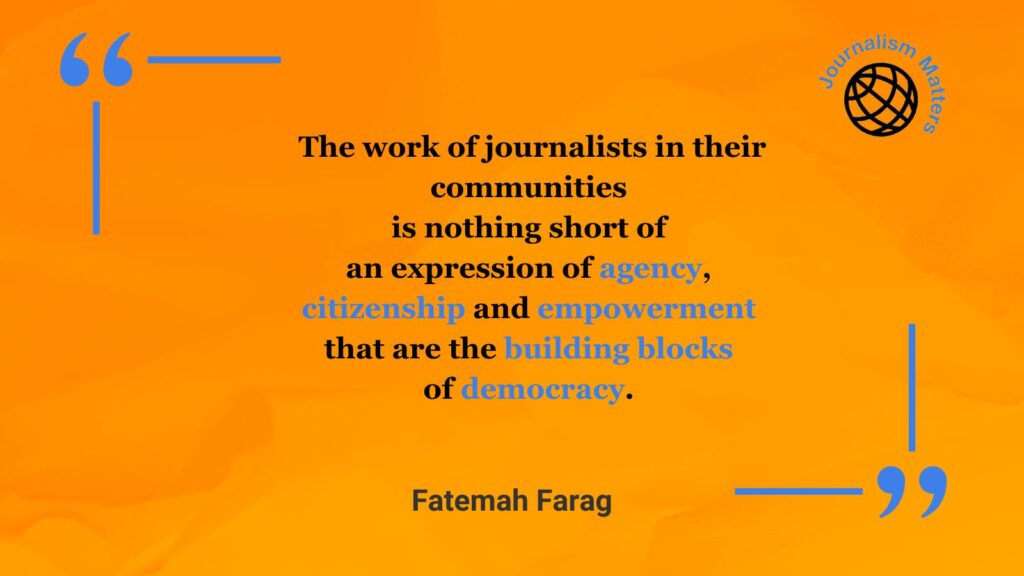
    As we near World News Day I am reminded of the adage “democracy is local” (Thomas Jefferson, all the way back then); the work of journalists in their communities is nothing short of an expression of agency, citizenship and empowerment that are the building blocks of democracy. 

    Everyone’s eyes focus on elections, big events and major changes when considering the viability of actions to bring about democracy.

    But from where I stand it is the daily hard work of citizenship on the small scale that can eventually build sustainable understanding and commitment to effective, inclusive democracy.

    And the work of those committed journalists who go to work everyday to report on and for their communities are central to that process.

    This is not an easy job. Building, managing and sustaining local, public service journalism capable of playing critical roles in supporting their communities is more often than not a thankless task. 

    Across the world money has dried up as the business of journalism has been threatened by big tech, jobs have been shed, quality has been compromised, resources are fragmented and the value of journalism is constantly contested. 

    Closing information spaces is an increasingly high risk. Just look at the past eleven months in Gaza where Israel has killed an unprecedented number of journalists with impunity. The latest count by CPJ documents at least 116 journalists killed in this war. And it is not just lives we are losing; credibility, too. 

    “Beware: if you continue to lie, you will grow up to be a CNN journalist,” quipped a popular meme in Arabic at the advent of the carnage against Palestinians in Gaza. And there were variations: a BBC journalist, etc. 

    The trust in Western media’s impartiality and standards has been sorely tested – and not just in the Arabic-speaking world, bringing back the ghosts of post 9/11 coverage, the Iraq War and even coverage of Trump and US elections. 

    And it seems that the very people we aim to serve are also increasingly jaded by mis-information/dis-information campaigns and audience mis-trust and avoidance are daily realities.

    We know, from our work in the heart of communities and from the disturbing trends that have paralleled the demise of local journalism, that independent journalism is critical in exploring and upholding truth. 

    “It is such a hard job,” confides a journalist as he mopped the sweat off of his brow in a field where he was reporting on farmers’ struggles in Egypt. And yet he stood his ground – and because he did, his community could find reliable information and make informed decisions about their daily lives. 

    He is not an internationally recognized figure; people rarely know the rank and file. But his work embodies the heart and soul of what journalism is – an act of service.

    We have lived firsthand the dangers posed to democracy by losing independent – particularly local – media. We are now confident in the knowledge that the survival of a diverse, proficient media sector is an essential cornerstone in that pursuit of humanity and freedom.

    We can have no more doubts with regards to the threat monopolies of big tech companies pose to our profession, and can think clearly about the value journalism brings to society and where we need to re-trench and set up boundaries. 

  • The challenges of journalism in exile in Cuba, Nicaragua and Venezuela

    The challenges of journalism in exile in Cuba, Nicaragua and Venezuela

    Forced into exile, veteran journalist and Golden Pen of Freedom alum Carlos Chamorro drives home the critical need to promote and support journalists in exile – who continue to deliver quality reporting and investigations, even under deadly conditions.

    A Russian spy center operates at an Army military base in Managua; Daniel Ortega’s bodyguard chief removed from office; MEFCCA minister fell for corruption in multimillion-dollar programs; Anxiety and silence among public workers after announcement of state “restructuring”; Rosario Murillo orders the fall of the head of the Army’s “Political Intelligence”.

    These are the headlines of some of the main journalistic investigations that we have published in recent weeks in Confidencial.digital, the independent media outlet that I founded 28 years ago in Nicaragua, and that I now run in exile from Costa Rica. 

    Our editorial office was raided twice by the police – without a court order – after a wave of social protests, followed by a violent repression against human rights, broke out in 2018. 

    In 2021, the media outlet was illegally confiscated by the Daniel Ortega dictatorship.

    All of our journalists were forced into exile to continue to do their journalism freely, and our independent sources of information are persecuted and threatened. 

    However, the news that we continue to publish about public corruption, the internal conflicts within the regime, the purges of high-ranking officials, the mass exodus of almost 10% of the population, and the use of Nicaragua as a springboard for the illegal export of migrants to the United States, are stories that no one hears about in the official press. 

    Our audiences, inside and outside Nicaragua, whether they are supporters or opponents of the regime, have an alternative source of information free from censorship, which also offers quality journalism to international audiences.

    Behind each of these investigations is the talent of young journalists, who do not submit to censorship and self-censorship,  and above all, the trust that sources, including public servants – civilians and military – maintain in the press in exile.

    History is repeating itself in Cuba and Venezuela. Independent journalism from exile is a mirror of the dark clouds that threaten the press in Latin America, and it is also an example of the resilience of good journalism. Where the rule of law has collapsed, and where civil society is also under siege or on the verge of extinction, the only defence of the independent press lies in its own credibility.

    In these three countries, dictatorships have criminalized freedom of the press and freedom of expression, to the point that journalists cannot identify themselves as such and must omit signatures from their articles to avoid being arrested. 

    In Nicaragua, journalist Víctor Ticay spent 17 months in prison, convicted of the alleged crime of “conspiracy” for having transmitted images of a religious procession on his Facebook account. 

    In Cuba and Venezuela, there are dozens of journalists in prison, accused of “terrorism” or “inciting hatred” for reporting on social protests or electoral fraud, and for expressing opinions on their social networks. 

    Meanwhile, the State exercises different forms of direct and indirect censorship, including blocking the Internet to prevent access to independent media. Despite these extreme restrictions, the independent press survives through an ecosystem supported by journalism in exile

    The Inter-American Press Association (SIP) this year awarded the “Great Prize for Press Freedom 2024”, its highest distinction, to Journalism in Exile “in honour of colleagues and Latin American media that are increasingly forced to move or emigrate due to the violence, threats and persecution by criminal groups, corrupt officials and authoritarian governments.”     

    SIP has documented a growing increase in the number of exiled journalists, “mainly from countries such as Nicaragua, Venezuela, Guatemala, Cuba and Ecuador, and internally displaced people in Mexico and Colombia.

    The phenomenon also includes the editorial staff of Cuba, Nicaragua and Venezuela, some of which have their operations abroad because they are victims of systematic persecution.”

    The challenges to continue doing journalism in exile are monumental. The most urgent is to provide security to journalists and collaborators, who are at risk, and to the news sources to communicate through secure channels. The most complex is to achieve financial sustainability of the newsrooms in exile.

    My colleague Luz Mely Reyes, editor in chief of Efecto Cocuyo in Venezuela, advocates for identifying “host countries that provide special protection” to exiled journalists so they can continue doing their work, while Carlos Manuel Álvarez, director of El Estornudo in Cuba, proposes the creation of new “support networks” and forms of international financing for the press in exile, which “is no longer something transitory.”

    Indeed, under the police state of authoritarian regimes, the press in exile is now a permanent condition.

    The onslaught of dictatorships against the press also poses a challenge to the international community: it is imperative to preserve the last reserve of all freedoms.

    This article was produced to mark World News Day, a campaign to draw attention to the need to preserve and promote independent journalism.

  • First, Choose Truth

    First, Choose Truth

    English marks World News Day by outlining what seeking truth means for journalists, and journalism – and calls for a commitment to seeking and reporting the truth, emphasising the vital role that quality journalism plays in informing and empowering the public.

    Journalism has long been, first and foremost, a calling to seek and report the truth.

    “Truth should be their idol, their first and last consideration always,” stated an 1853 article titled Truth in Journalism, published in Scientific American Magazine

    “Seek truth and report it,” states the first ethic of the Society of Professional Journalists’ Code of Ethics, first drafted in 1926. 

    “Journalism’s first obligation is to the truth,” echoes Principle 1 of The Elements of Journalism, the now classic 2001 work that speaks to the essential responsibilities of journalists.

    This year, on World News Day, a global initiative to draw public attention to the role that journalists play in providing trustworthy news and information that serves citizens and democracy, we draw together around the world to “Choose Truth.”

    World News Day is organised by the Canadian Journalism Foundation (CJF), the World Editors Forum and the South Africa-based Daily Maverick’s Project Kontinuum. 

    The annual September initiative was first launched by the CJF in 2018 to enhance the relationship between the news industry and its audiences. 

    From the outset, the goal was to create a greater public understanding of why quality journalism matters – especially in a world polluted by misinformation.

    The theme of this year’s World News Day, “Choose Truth” is the first global campaign from Project Kontinuum, which was established by Daily Maverick founder and editor-in-chief Branko Brkic, to reaffirm journalism’s critical role throughout the world.

    This message could not be more critical or more timely. 

    ‘In a world in which we have increasingly witnessed fiction become fact and misinformation turn mainstream, choosing truth has perhaps never been more important – or more difficult.’

    For the public, this means the need to distinguish between real news and rumours and falsehoods masquerading as fact, a challenge ever more difficult in this era of AI-generated digital content and “bad actors” intent on sowing public discord with malicious disinformation. For journalists, it means doubling down on our core principle to serve the public with truth grounded in thoroughly verified fact. 

    To choose truth requires that trust be the foundation of the relationship between the public and the journalists who seek to serve the public good. But, as the 2024 Digital News Report of Oxford University’s Reuters Institute for the Study of Journalism, tells us: “… across the world, most of the public does not trust most of the news most of the time.” 

    What does journalism’s obligation to seek truth and report it mean? 

    It demands a staunch commitment to being trustworthy. That means being accurate and fair, dedicated to a transparent process of verifying the facts that form the foundation of truth. 

    It means telling our audiences what we know and how we know it – being clear about our sources of information. 

    It means understanding that on any given day, the facts we find may well be “the best available version of the truth” not the whole story and thus, we must always scrupulously update the facts as we learn more, and correct our mistakes when we err.

    In a polarised world, too many can’t agree even on what is a fact and argue that truth is dead. That makes it all the more critical for both responsible journalists and the public to understand what constitutes trustworthy, evidence-based information. It is not simply a matter of delivering and consuming the news; it is about empowering people with the facts they need to navigate their world. 

    ‘A timeless truth: Facts are complex and truth is not always self-evident. Journalism is not infallible.’ 

    As Rasmus Kleis Nielsen, outgoing director of the Reuters Institute wrote in 2018, “For both journalists and the public, the basic journalistic aspiration of finding truth and reporting it is of enduring importance, as are all the ways in which journalism can empower people by helping keeping them informed about, oriented in and engaged with the world around them.”

    The truth is, quality journalism in the public interest matters. 

    Facts matter, Truth Matters. 

    On this World News Day, we must all – journalists and citizens alike – Choose Truth.

    Kathy English, chair of the board of the Canadian Journalism Foundation, served as public editor of the Toronto Star for 13 years.
    She was a Journalism Fellow at the Reuters Institute in 2020/21.

  • Dame Frances Cairncross for World News Day

    Dame Frances Cairncross for World News Day

    Do you still buy a daily newspaper? Or perhaps a Sunday paper? If you do either, you are probably aged over 40, and in a dwindling minority in most parts of the world. You may well still look at the news on your phone, perhaps checking the “snippets” that Google News offers you for free. You may watch the news on television or listen to the radio. But you are much less likely to pay for news that your parents were – let alone your grandparents.

    In one sense, this is a golden age for news. Twitter, TikTok, YouTube and of course Google all offer news stories. Facebook encourages friends and families to chat about it, and to compare notes on evolving local news. Why pay good money to buy a paper, or sign up for a subscription, when you can get the gist of the main stories for nothing?

    The obvious answer is that none of those sites employs professional journalists, who understand how to grasp the essence of a story and package it for a large audience. Take the astonishing achievement of Robert Moore and his team of Britain’s ITV on January 6 2021. Having guessed that there might be trouble before the inauguration of Joe Biden, and suspecting that the Capitol might be involved, he made it into the building with a cameraman and a producer, the only group of journalists to breach the perimeter. Or take the shattering scoop by two journalists on the Financial Times, who in October 2021 took US intelligence by surprise with a story that China had tested a new hypersonic missile with devastating space capability. Both items of news took trained fulltime journalists – with specialised skills and luck on their side.

    Television news survives on advertising – and vast amounts of advertising that once paid much of the cost of newsgathering has now migrated to Google and other online sites. Newspapers like the Financial Times need paying customers as well as ads. Many newspapers are now free online – even if they still charge for their paper version. But that cannot be a longterm business proposition. In 2019, I edited a report to the British government on “A Sustainable Future for Journalism”, which looked closely both at the plight of the news business and at possible ways forward. 

    The Report argued that, while there was certainly not a case for blanket government subsidies for news, there were some kinds of news that were particularly important in preserving honest government and well-informed citizens. The report called that “public interest news”, and argued that it was especially important at a local level. Good government – and especially good local government – needs trained reporters, who follow not just local public-spending decisions, but the governance of schools and hospitals, and the verdicts in courts of law. Without coverage by trained reporters, these functions of local administration can suffer poor from management and wasteful or unfair spending decisions.

    Any mechanism for giving financial help to news businesses needs to be designed with great care. But the best kind of financial help is the payment that citizens willingly make to subscribe to an online (or indeed a physical) source of news. Subscriptions are on the increase for quality news online – for The Economist, for instance, and The Guardian, both of which have increasing numbers of international readers. But the more populist news sources in the UK – the Mail, say, or the Sun – have hesitated to ask online readers to subscribe (although they still charge for their paper versions). This division is troubling, if only because publications like the Sun and the Mail have often deftly slipped serious news in amongst raunchier stories. They have been important sources of improving media literacy. And local papers have, down the years, been the glue that often holds communities together. The survival of these news sources matters even more for good government and watchful citizens than does the future of the upmarket press. 

    About the author

    Dame Frances Cairncross is a British economist, journalist and academic. She is author of The Cairncross Review: A Sustainable Future for Journalism. She is formerly a senior editor at The Economist and an economics columnist at the Guardian.

    She is a Senior Fellow at the School of Public Policy, UCLA. She is a former chair of the Executive Committee of the UK’s Institute for Fiscal Studies. From 2004 to 2014, she was the Rector of Exeter College, Oxford.

  • David Walmsley: The convening power of independent journalism has never been more important

    David Walmsley: The convening power of independent journalism has never been more important

    Making a positive difference to someone’s life is the greatest gift a journalist can give. Perhaps an individual is heard for the first time, or an injustice is settled. 

    Those moments when a news editor picks up a phone to hear a scared voice say, ‘you are all I have left, I have nowhere else to turn’. The last stand between hope and defeat. 

    It is a sacred contract, as old as journalism itself yet the tenor of our times would try to divide the people from the newsrooms. If those who attempt to turn journalists into the enemy are successful, the people’s right to independent access to information will be lost. And as we all know a world where people are blinded from facts is a dangerous one.  

    During the global pandemic, record audience numbers were reported around the world as readers, viewers and listeners absorbed the news and information that saved lives. Nevertheless, an ever more vociferous minority pedalled a derogatory term, the so-called “mainstream media” – as if being together in a fact-based environment is a bad thing. 

    That’s because the facts can sometimes be uncomfortable, and journalists have a big responsibility to get them right. 

    We know that since World News Day began in 2018, the challenges facing the industry have only grown. We may better understand the commercial pressures and the ever-changing audience habits, but we still don’t do enough to explain ourselves. 

    That means newsrooms have their work cut out. Explaining methodology and how facts are uncovered has become as important as the facts themselves.  

    Those who are potential audience members consume most of their information in closed, fast-paced networks. We have seen examples time and again where small but active minority groups simply believe what they are told, often by powerful forces with something to hide. The journalist is used as bait in an attack against uncomfortable truths. As a result, the industry has to devote more time to reaching those who have already decided the facts even without possessing them. 

    Walled environments exist across the Internet preventing plurality of thought and opinion, fact and reality from being shared. Amid the myriad challenges facing us all, certainty is one of the least attractive traits on display. 

    World News Day, involving more than 500 newsrooms, is a global initiative aimed at improving media literacy and audience engagement. We include examples of how lives are improved when journalists tell a story. We showcase the efforts of small newsrooms as they represent the importance of community. We underpin all our work with the belief that access to information is a human right. 

    The speed of change, and the dangers and risks in society sometimes seem only to go in one direction leading to a global audience that is both exhausted and saturated with information. We have constructive roles to play amid the extraordinary news developments.  

    The convening power of independent journalism has never been more important, and sadly because of that hyper-relevance the risks and threats to journalists, your storytellers, only grows. The speed of polarization, an 18th century term used originally to identify the characteristics of light in photography, today makes agreement unfashionable. But as newsrooms around the world often say, we are all entitled to our opinions but we are not entitled to our own facts. 

    War, economic uncertainty, a determination to run roughshod over generational practices at our institutions are the changes facing the world. Journalism at its best is in the middle of it all, with a role to sew not division but mutual understanding and transparency. 

    World News Day exists to help the news industry to explain itself better, to involve the global audience in showcasing how accurate information makes life better.  

    The US president, Joe Biden, was born closer to Abraham Lincoln’s presidency than his own. That perspective shows less the age of the man and more the opportunities and advances that have been taken in the past century, raising with urgency the questions of where we go from here. 

    About the author 

    David Walmsley is the Editor-in-Chief of The Globe and Mail and is the founder of World News Day.